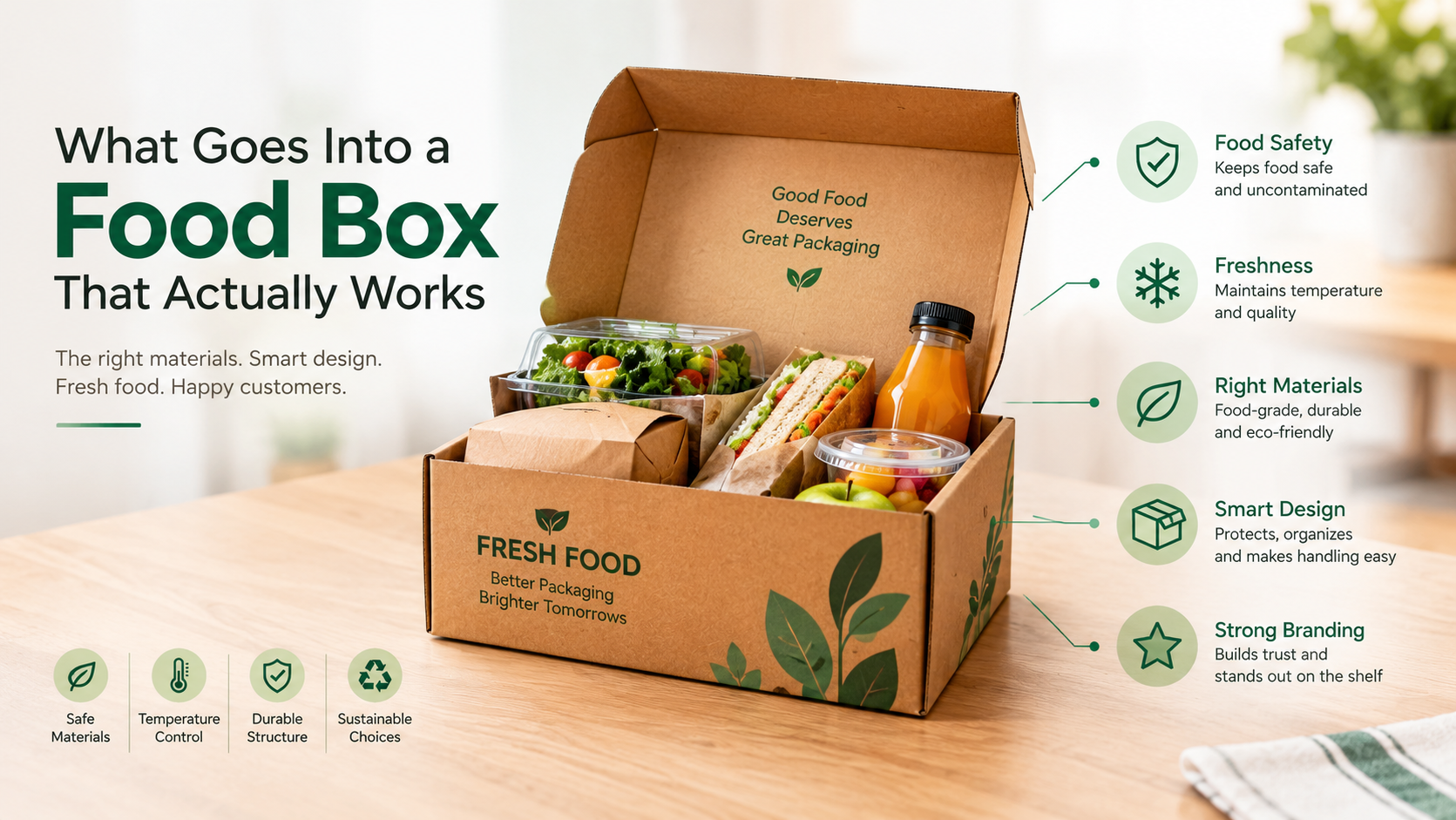
A food box has one job most other packaging doesn’t: keep something edible safe, clean, and appealing all the way from a kitchen or a warehouse to someone’s table. Get that wrong, and it’s not just a packaging complaint, it’s a bad experience with the actual product itself.
Why Food Packaging Can’t Be an Afterthought
Generic product packaging built for non-food items usually skips things a food box can’t afford to skip: grease resistance, proper ventilation, food-safe coatings. A box that works fine for a candle will fall apart, literally, the moment it touches something warm and oily. This isn’t a small technical detail either, it’s the difference between food arriving the way it left the kitchen and food arriving as a mess someone has to apologize for.
Most businesses only discover this gap the hard way, after a customer complaint, not before. By then, the cost isn’t just one ruined order, it’s the trust that order was supposed to build.
When Food Packaging Starts Doing a Second Job
Chocolate, baked goods, gourmet snack sets, these sit in a strange middle ground where the box stops being just food packaging and starts being gift packaging too. Someone receiving a box of chocolates cares just as much about how it looks in that first second as how it tastes a minute later.
Chocolate specifically is fragile in ways a lot of packaging doesn’t account for. Heat softens it, pressure cracks it, even a bumpy delivery ride can ruin a piece before anyone’s had the chance to taste it. Custom chocolate boxes deal with this through built-in dividers, a snug internal fit, and enough rigidity that a small bump in transit doesn’t turn a nice gift into a melted disappointment.
For higher-end food gifts, artisanal cookies, gourmet snack sets, specialty coffee, custom rigid boxes show up constantly for a similar reason. They hold their shape under weight, feel solid the moment someone picks them up, and generally read as premium before the box has even been opened. A flimsy box undercuts even genuinely good food, which is a strange but real problem bakers and specialty food brands run into more often than they’d expect. Nobody blames the box out loud, but the impression sticks anyway.
A Logo Does More Work Than People Assume
Custom gift boxes with a logo for small businesses work especially well for food brands trying to build recognition without a big marketing budget behind them. Unlike a plain paper bag, a printed box sticks around a little longer. It sits on a counter, gets noticed before anyone’s opened it, sometimes ends up in a photo before it’s even been touched. That’s brand exposure a receipt or a to-go bag simply doesn’t provide.
Over time, that repeated visibility adds up to something bigger than any single order. A customer who sees the same branded box three or four times starts recognizing it before they’ve even read the name on it.
Bigger Occasions Change What the Box Needs to Do
Holiday gift sets, wedding favors, milestone celebrations, these all lean on luxury gift boxes for special occasions because the packaging has to match how much the moment actually means to the person giving it. Foil accents, ribbon closures, a heavier board, small details that change how a food gift feels the instant it’s handed over rather than opened later at home.
This matters more in food than people expect. A holiday cookie set in a plain box reads as an afterthought. The exact same cookies in something with a bit of finish read as intentional, even though the contents never changed at all. The food did all the work in the kitchen. The box has to finish the job on the way out the door.
Consistency Becomes the Real Challenge at Scale
Sending food gifts to a full client list, or handing out treats across an entire office, isn’t the same task as picking out one nice box for one person. Personalized gift boxes for corporate gifting solve the consistency problem here: every box in a run of fifty or five hundred has to look intentional, not thrown together at the last minute by whoever had time that afternoon.
This is usually where the difference between a good supplier and an average one becomes obvious. Anyone can make one box look nice. Making five hundred look identical, on a deadline, without the quality dipping by unit three hundred, is a different skill entirely.
Custom Doesn’t Have to Mean Expensive Anymore
There’s an old assumption that custom packaging automatically means a bigger spend, and that’s mostly outdated now. Affordable custom gift boxes online have gotten a lot more realistic for small food businesses, mainly because manufacturers dropped their minimum order sizes and cut out layers of unnecessary markup that used to sit between a bakery and the actual factory.
That shift matters most for the businesses that used to get priced out entirely: the home baker scaling into a real storefront, the coffee roaster who wants branded bags before they’ve hit their first thousand units sold. A few years ago, both of them would have been quoted minimums that made custom packaging pointless at their current size.
Two Things That Get Overlooked Until They Cause a Problem
Grease resistance and structural weight rarely get mentioned until a box fails at exactly the wrong moment: a stack of cookies sliding sideways in a delivery bag, a bottom soaking through right before a customer opens the lid in front of everyone. Neither issue shows up in a mockup review. Both show up the first time real product sits in the box for more than twenty minutes.
Buy Custom Box tests for exactly that gap: greasy, heavy, or delicate items sitting in a box for the length of an actual delivery, not just a quick look under studio lighting. It’s a small difference in process, but it’s usually the reason one supplier’s boxes hold up and another’s don’t, and it’s the difference a customer notices even when they can’t quite explain why one delivery felt better than another.